This Small Door #13 - GUEST POST!
A guest post by poet Debmalya Bandyopadhyay

We, at This Small Door, are very happy to continue our series of guest posts by poets we love and admire. If you haven’t already read it, our first guest post was by poet Claire Wahmanholm. Today, we have an absolutely delightful piece by one of our favourite poets, Debmalya Bandyopadhyay. It is an absolute privilege and a gift to have poets close-read a poem & share their insights with us. We hope you will find as much value from reading this as we did. Please enjoy! - Kinjal, Yashasvi, Kunjana
Bear of the Artist
Chrissy Williams

I asked the artist to draw me a heart and instead he drew a bear.

I asked him, ‘What kind of heart is this?’ and he said, ‘It’s not a heart at all.’

I asked him, ‘What kind of bear is this?’ and he said, ‘It’s not a bear either.’

I asked him, ‘What kind of artist are you anyway?’ and he said,

‘I am the one who exists to put bears in your head, who exists

to put ideas in your head in place of bears, who mistrusts anyone

who tells you they know what kind of place the heart is, the head,

how it should look, what size, what stopping distances, etc.,

and as long as you keep me existing to put bears in your head

I will, because nights are getting darker, and we’re all tired,

we’re all so tired, and everyone could use a bear sometimes,

everyone could use a wild bear, though they can be dangerous

and there’s nothing worse than a bear in the face, when it breaks –

always remember how your bear breaks down

against the shore, the shore, the shore.’
Debmalya:
I had heard this poem before I had read it, recited by Bohdan Piasecki whose creative writing class I was attending in the spring of 2023. It intrigued me so much that I immediately got Chrissy Williams’s collection Bear, which opens with this poem.
The apparent premise of the poem is set out in the first line. I like that the first few lines keep negating something—what the artist has drawn isn’t a heart and isn’t a bear. This subverts all my expectations from the (benign) title and the first line. The rules of the poem’s world are suddenly uncertain and I’m bracing myself for anything.
The rest of the poem is a single-sentence monologue of the artist, which draws me closer to itself with each line. It opens with the artist describing his purpose—to the ‘I’ who is now also the reader, and starts unspooling the thread of uncertainty further. Turns out, the artist is also distrusting of any certainty of the interior landscape—the head and the heart. Classic. I love the use of ‘what stopping distances’ in here, which evokes many interpretations. How far are we allowed to travel inside someone’s head? Inside our own? How far does a bullet travel?
There is a leap after this, because the ‘I’ is referred again and the ‘keep me existing’ suggests that the ‘I’ is responsible for his presence. Spot on, I have not been able to forget the artist since reading the poem, so he still puts bears in my head. But he is not constrained to the head, his shadow looms larger as he says the ‘nights are getting darker, and we’re all tired’. I like the shift from you to we which makes him feel larger. The energy of the poem steadily grows from here. A couple of phrases are repeated — ‘we’re all so tired’ — accentuating the weariness, and ‘everyone could use a wild bear’— trying to convince us. There is a sense of comfort in these two lines; even though I don’t know what one does with a bear, I want to agree with the artist. But he immediately snatches away the warm blanket and contradicts himself, reminding how dangerous a bear actually is. (Hello, imagine a wild bear on your face?!) Alright, got me there.
There is a clever use of the word ‘breaks’ here, I think this literary device is called zeugma, where the same word serves different purposes. The bear on the face breaks something, and although ‘tears’ may have been a natural choice here, I’m sure there’s plenty to break. The sense of trust or comfort we had for the bear is broken, alongside a few bones. But right after it’s the bear that breaks down against the shore. Once again, when the impending violence is heightened, the possibility of harm is quickly upended, and we are returned to the safety of the shore.
I love ‘the shore’ being repeated in the final line, the comedown after a crescendo. It not only evokes waves at a shore (the stable rhythm of the waves is a more placid image to let go of the reader) but it makes me think that the artist is now retreating, that he is farther away, and the wind carries the echo of his voice to me. In fact, the entire monologue feels somewhat like a hypnotic voice slowly filling into my head—which of course—has no stopping distance.
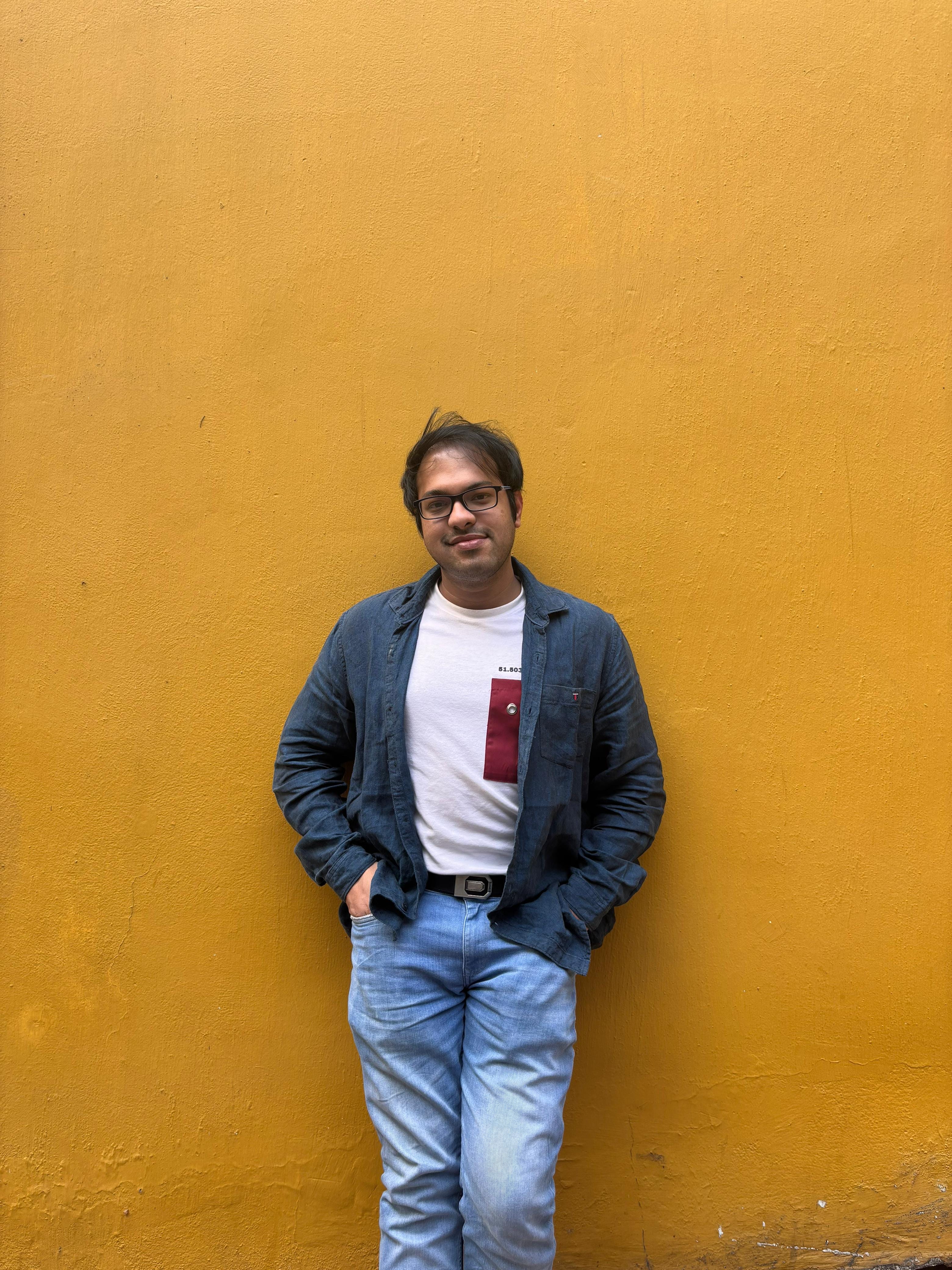
Debmalya Bandyopadhyay (he/him) is a writer and mathematician. He is a 2025 graduate of the Brooklyn Poets Mentorship Program. He is the winner of the Verve Poetry Prize 2026, a runner-up of the UK Poetry Coaches Slam 2025, and was a finalist for the Tupelo Quarterly Poetry Prize, Grouse Grind Lit Prize, Osmosis Poetry Prize, Sweet Literary’s Poetry Prize, and the Briefly Write Poetry Prize. His poems, translations, and essays have appeared or are forthcoming in Blackbird, Wildness, Chestnut Review, South Carolina Review, Atlanta Review, and elsewhere. He is often in parks confabulating with local birds.
An absolutely delightful poem and a close reading that does it justice!